
Container Desiccants in Containers: Best-Practice Guide
Dry cargo, perfect arrival
How to use SECAL container desiccants properly so that container rain, mould and corrosion never reach your cargo: where to hang them, how many to use and what to check before you close the doors.
1. The problem: moisture travels with your cargo
Inside a closed container, the temperature swings between day and night — and between ports — make water vapour condense on the roof and walls. This is container rain: drops that fall on the cargo and cause mould, rust, stains and collapsed cartons.
Container rain
Vapour condenses on the roof and drips onto the cargo during the voyage.
Mould and fungi
High humidity favours fungi on textiles, leather, coffee, timber and cardboard.
Rust and corrosion
Metal parts and machinery corrode under sustained condensation.
SECAL container desiccants capture the water vapour inside the container and hold it, keeping relative humidity below the point where condensation forms.
2. The product: SECAL 750 g
The 750 g unit is the one most used for ocean containers: it balances capacity against the number of units you have to place. Anhydrous calcium chloride with starch absorbs more than three times its own weight in water and holds it as a gel, so nothing drips.
| Specification | Value |
|---|---|
| Composition | Anhydrous CaCl2 + starch |
| Absorption capacity | >300% — more than three times its weight |
| Water retained per unit | >2.25 kg |
| Format | 750 g bag with hook |
| Retention | Gel — does not drip |
| Use | Ocean containers, rail, road |
The starch gels the absorbed water so it cannot run onto the cargo. Real absorption depends on humidity, temperature and voyage length.
3. The two golden rules
How well a desiccant works depends almost entirely on how you place it. These two rules change the result more than anything else.
Never cover it with cargo
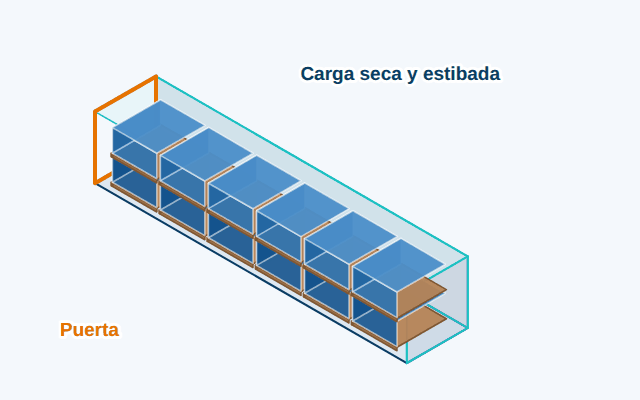
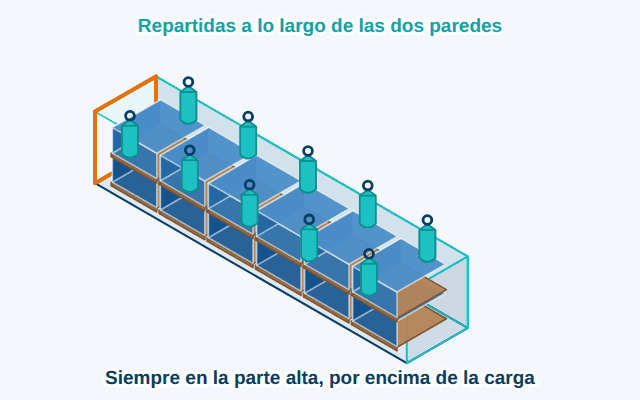
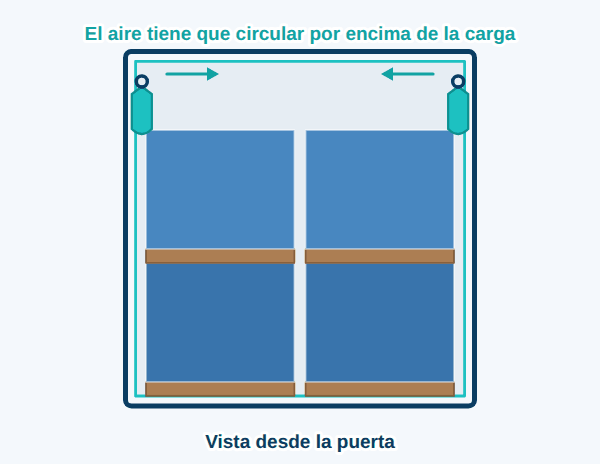
The desiccant needs air moving around it to capture vapour. Leave it exposed — never crushed between packages. Hang it from the lashing rings or the top rail and keep a gap between the cargo and the bag.
Spread them in a zigzag
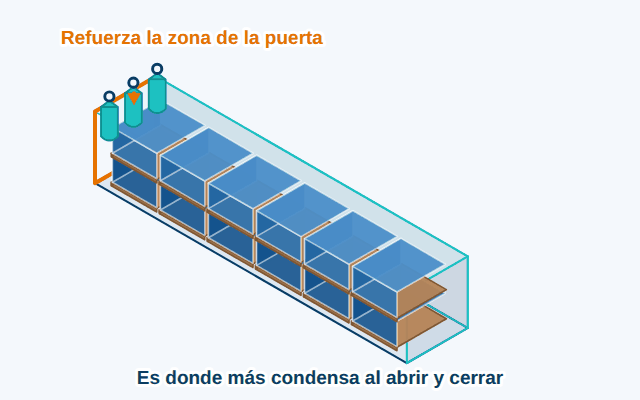
Alternate them on both sides along the length of the container. All of them in one row, or piled at one end, leaves the far end unprotected — and that is where condensation appears. Reinforce the corners and the door area.
4. Step by step, in the order it happens
Before loading — prepare and measure
Check that the container is dry, clean and leak-free. Do the light test: close the doors and look for points of light. Measure the moisture of the container floor (timber must not exceed 18–20%), of the cargo and of the packaging. Factor in the route: tropical or monsoon legs carry more moisture and need a higher dose.
Opening the pack — take out only what you will use
Desiccants start working the moment they meet the air. Open the pack only when you are about to place them, and take out only the units for the container you are loading. Reseal the rest at once in their airtight bag: left exposed, they lose much of their capacity in 24 to 48 hours.
Placing them — exposed and in a zigzag
Hang them from the lashing rings or the top rail, never flat on the floor and never under the cargo. Alternate sides along the container and reinforce corners and the door area, where moisture concentrates most.
Closing — seal and document
Close the container immediately: every minute it stays open lets moisture in. Write down how many units you placed and where, and take a photo — it is your evidence if a claim is filed.
5. Opened the bag? Reseal it
The rule: take out only the units you are going to use now, and reseal the rest immediately in an airtight pack.
Once exposed to air, desiccants lose a large part of their capacity within 24 to 48 hours. A properly resealed pack keeps them ready for the next shipment.
6. Measure the moisture, then set the dose
The dose is not fixed. It depends on how much water your cargo and its packaging bring with them, on the route and on how long the voyage lasts. Measure it: if the moisture reading goes up, the dose you have been using is probably no longer enough.
What to measure
Moisture of the cargo (coffee, grain, timber, textiles and leather carry their own water); of the packaging (cartons, sacks, timber pallets); of the container floor (not above 18–20%); and the climate at origin and destination.
How to adjust
If you find more moisture than usual — damp packaging, a rainy route, a long voyage — raise the dose. If cargo and packaging are well dried and the route is short, you can hold it or lower it. A dose that worked before can fall short once the moisture changes.
| Container | Low risk | Medium risk | High risk |
|---|---|---|---|
| 20 ft | 5 units | 6–7 units | 8 units |
| 40 ft | 8 units | 12 units | 16 units |
| 40 ft HC | 10 units | 13 units | 18 units |
750 g units. Low risk = dry route and short voyage; medium = mixed route; high = tropical or monsoon route, or a long voyage of 30–60 days. That is roughly 4–6 kg for a 20 ft and 8–12 kg for a 40 ft, the industry reference range.
If you want to go beyond the table, the order of magnitude can be estimated as grams of desiccant = relative humidity (%) × container volume (m3) ÷ absorption rate, taking an absorption rate of about 3 g of water per gram of calcium chloride. Real absorption still depends on voyage length, temperature, container ventilation and how hygroscopic the cargo is.
7. At a glance
Do this
- Container checked: dry, clean, no leaks
- Hung from lashing rings or the top rail
- Spread in a zigzag along both sides
- Extra units at corners and the door
- Only the units you need taken out of the pack
- Doors closed immediately
Not this
- Covered or crushed between the cargo
- All piled at one end
- Laid directly on the floor
- The master bag left open to the air
- Loading with damp packaging or wet timber
- The same dose whatever the conditions
Mistake number one: covering the desiccants with cargo. With no air around them they capture nothing, and the container ends up with condensation even though you placed the right quantity.
8. Frequent questions
Why can a desiccant not sit directly on the cargo?
Because it needs air circulating around it to capture vapour. Crushed between packages or covered, it does not absorb. And although SECAL holds the water as a gel, keeping a distance from the cargo is good practice.
Why a zigzag instead of keeping them together?
So that absorption is even throughout the container. Put them all at one end and the other end is left unprotected — that is exactly where condensation shows up.
I opened the bag and have units left over. What now?
Reseal them at once in their airtight pack. Exposed to air they lose capacity in 24 to 48 hours; properly closed, they are ready for the next shipment.
How often should I recalculate the dose?
Every season, or whenever conditions change: damper packaging, a longer or wetter route, the rainy season. If you measure more moisture than before, raise the dose.
Does it work for air freight?
Container desiccants are used in ocean containers, rail wagons and trucks. For air freight, ask your SECAL adviser which solution fits.
How much water does one unit really hold?
More than 2.25 kg — over three times its own weight. The certificate of analysis figure is 307% at 60 °C and 90% relative humidity.
How many desiccants does your cargo need?
Tell us your cargo, route and season and we will work out the type, the quantity and where to place them.
This guide is a reference. Confirm product, dose and placement with your SECAL adviser according to your cargo and route. SECAL technical guides · PROTEXPO S.A.C. / SECAL, Lima, Peru.